Soccer Drill
3v2 Attacking with Target Player
Description
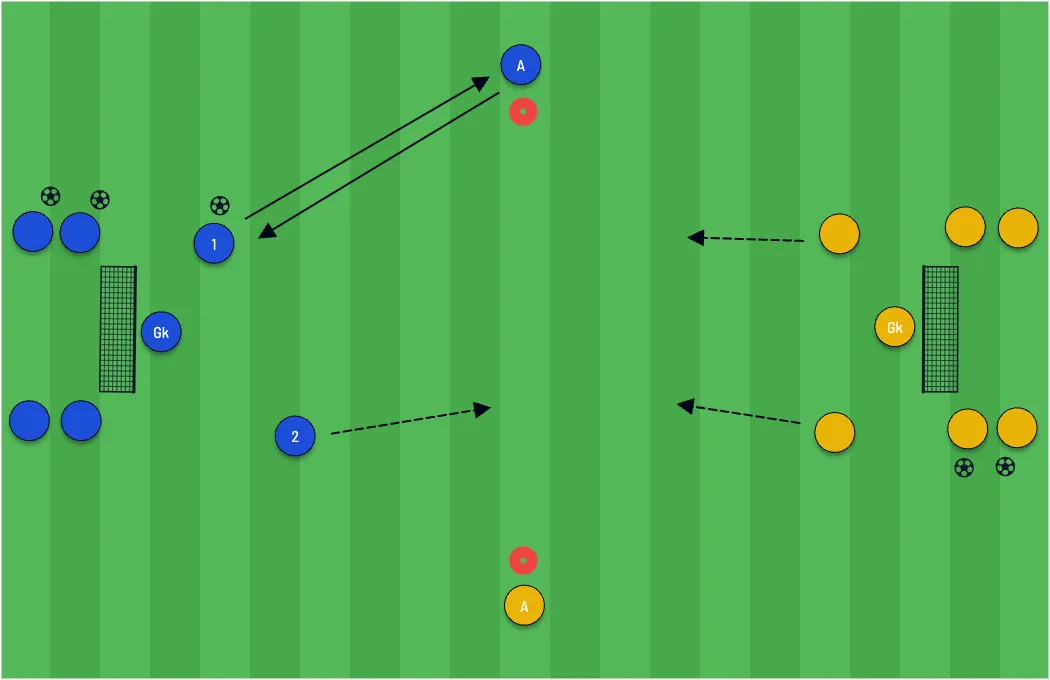
This is a directional attacking game that helps players practise movement, passing, combination play, attacking with an overload, and quick transition to defend.
Set up a pitch with a goal at each end and a goalkeeper in each goal. Split players into two teams. Each team has a line of players behind their own goal and one permanent attacker positioned high up the pitch.
The exercise starts with the first blue pair entering the pitch. Blue player 1 starts by passing into the blue permanent attacker, A. The attacker must play the ball back to either blue player 1 or blue player 2. Once this return pass is made, the game becomes 3 blue attackers against 2 yellow defenders going to goal.
The blue team tries to combine quickly and score. The yellow defenders try to win the ball and stop the attack.
When the ball goes out of play, a goal is scored, defender wins the ball or the goalkeeper saves it, the wave is finished. The two blue players (1 & 2) who attacked now stay on the pitch and become defenders. The first yellow pair from behind the opposite goal enters with their permanent attacker, creating a new 3v2 attack in the other direction.
The game continues as a wave practice, alternating attacks from each end.
Coaching Points
- The player on the ball should decide: dribble if space opens, pass if a defender commits.
- Look for quick combinations: wall pass, overlap, through pass, or pass across goal.
- Finish attacks with purpose; avoid taking too many touches near goal.
- Play into space, not always directly to feet.
- As soon as the attack ends, the two attacking players must react and become defenders.
- Encourage a quick mental switch: attack is over, defend immediately.
- New attackers should enter quickly so the tempo stays high.
Defenders
- The first defender should slow the attack down, not dive in.
- The second defender should cover the space behind and protect the goal.